
2026
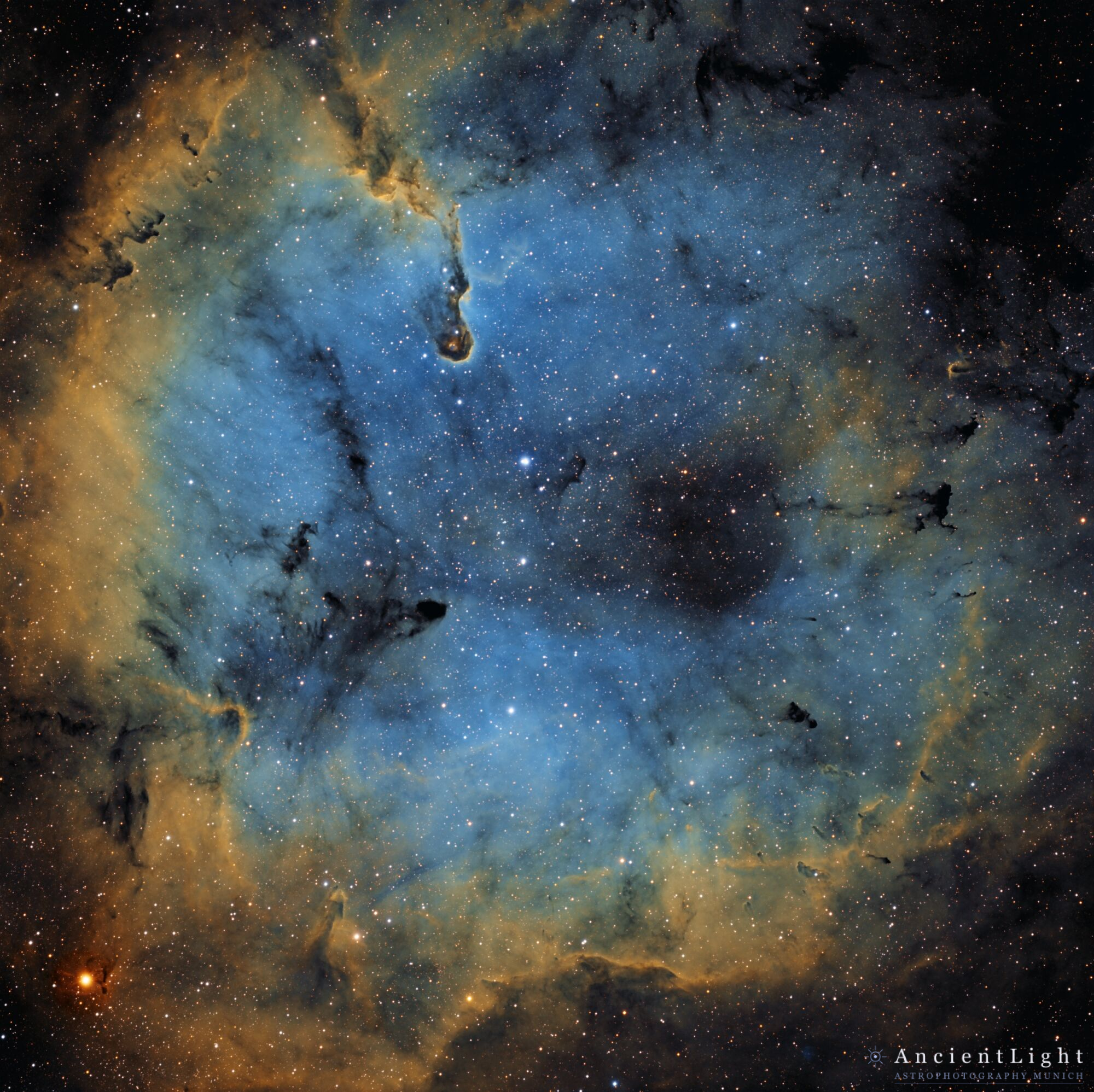
IC 1396 Elephant's Trunk
The Elephant's Trunk Nebula (IC 1396) is a concentration of interstellar gas and dust within the much larger ionized gas region IC 1396 located in the constellation Cepheus about 2,400 light years away from Earth. The nebula is a dark, dense globule that gets its name from its appearance at visible light wavelengths, where there is a dark patch with a bright, sinuous rim. The bright rim is the surface of the dense cloud that is being illuminated and ionized by a very bright, massive multiple star (HD 206267) that is just to the east of the Elephant's Trunk Nebula.
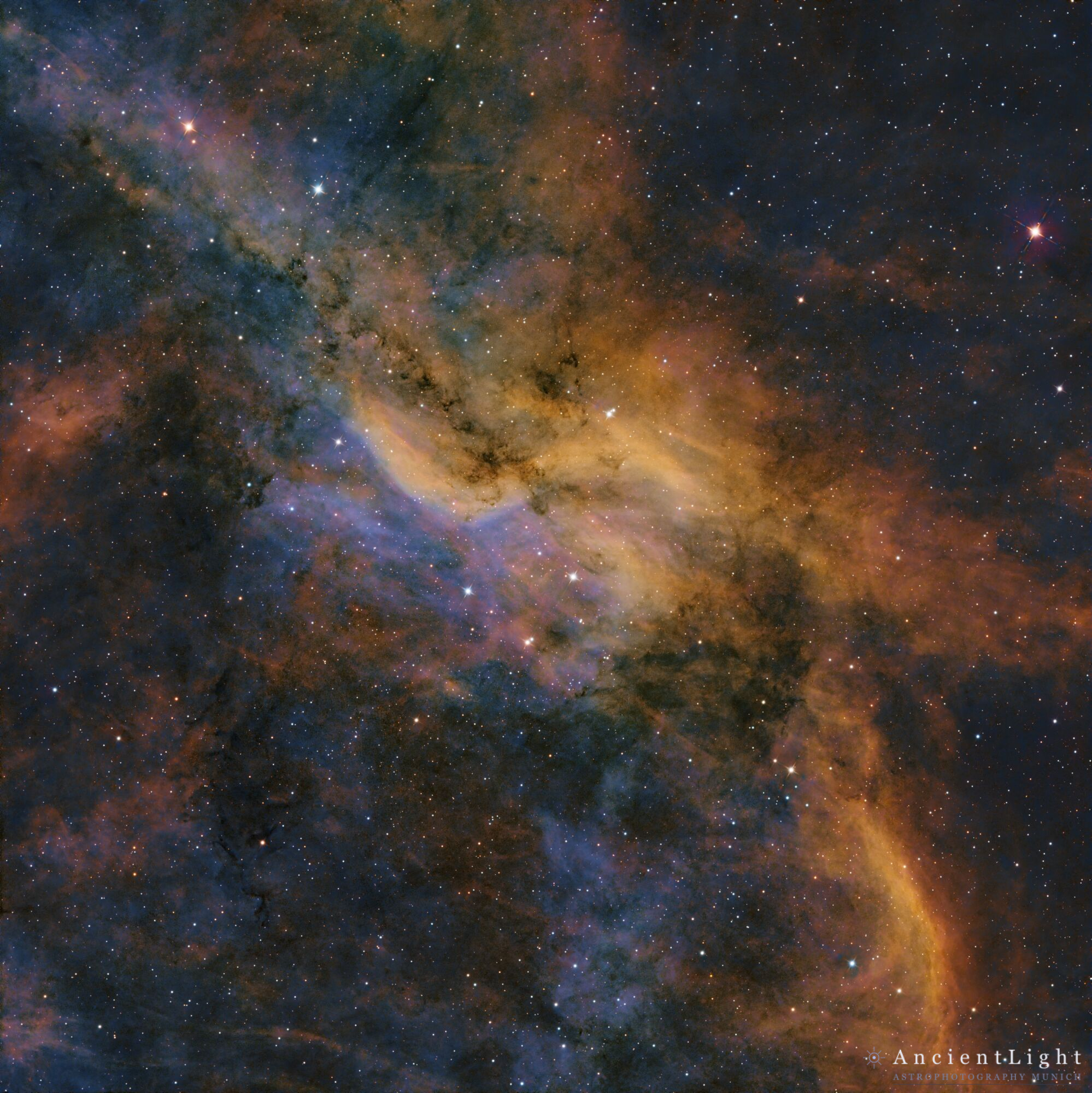
Propeller Nebula (Simeis 57) in Cygnus
Simeis 57, popularly known as the Propeller Nebula, is a faint emission nebula located in the Cygnus constellation. Discovered in the early 1950s at the Simeiz Observatory in Crimea, it sits about 5,500 light-years away within the expansive Cygnus X molecular cloud complex. It is relatively low in density. While the exact ionizing source is debated, studies suggest the energetic ultraviolet radiation may originate from the massive Wolf-Rayet binary star WR 140, despite it being separated by a large angular distance. Munich Bortle 6 · 2026-07-09/10/11 · TS PHOTON 154 f/4 · Umi17R · ToupTek 533M · 12h05m SHO · N.I.N.A · Pixinsight
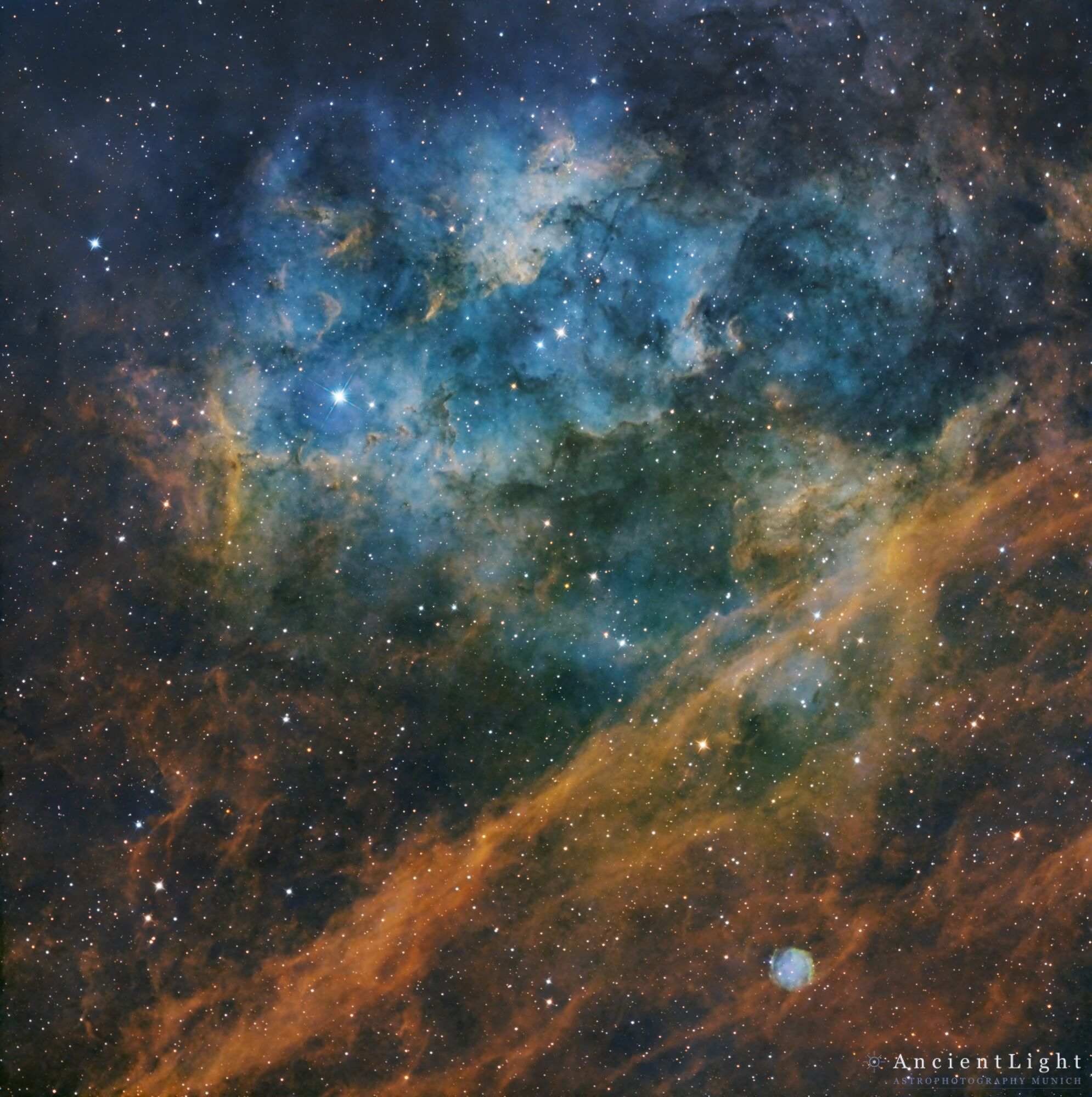
Sh2-115 in Cygnus
Sh2-115 is a faint, large emission nebula in the constellation Cygnus, located about 7,500 light-years away. Situated 2–2.5° northwest of the bright star Deneb, it features chaotic gas emissions and glowing filaments ionized by the young star cluster Berkeley 90

M101 Pinwheel Galaxy in Ursa Major
The Pinwheel Galaxy (Messier 101) is a face-on, counterclockwise intermediate spiral galaxy located 21 million light-years from Earth in the constellation Ursa Major. M101 is a large galaxy, with a diameter of 252000 light-years. By comparison, the Milky Way has a diameter of 87400 light-years. It has around a trillion stars. M101 has a high population of HII regions, many of which are very large and bright.
Munich Bortle 6 (L) + Etzelwang Bortle 4 (RGBH) · 2026-05-09/10/22-26 · Skywatcher 200P f/5 · Umi17R · ToupTek 533M · 16h10m LRGB 9h50m Ha · N.I.N.A · Pixinsight
Munich Bortle 6 (L) + Etzelwang Bortle 4 (RGBH) · 2026-05-09/10/22-26 · Skywatcher 200P f/5 · Umi17R · ToupTek 533M · 16h10m LRGB 9h50m Ha · N.I.N.A · Pixinsight

M106 Galaxy in Canes Venatici
Messier 106 is an intermediate spiral galaxy in the constellation Canes Venatici at a distance of about 22 to 25 million light-years away from Earth with a diameter of about 125000 light-years. It is one of the largest and brightest nearby galaxies. The supermassive black hole at the core has a mass of (3.9±0.1)×107 M☉.
Munich Bortle 6 · 2026-04-19/22/23/24/30,2026-05-01 · TS PHOTON 154 f/4 · Umi17R · ToupTek 533M · 36h27m LRGB+Ha · N.I.N.A · Pixinsight
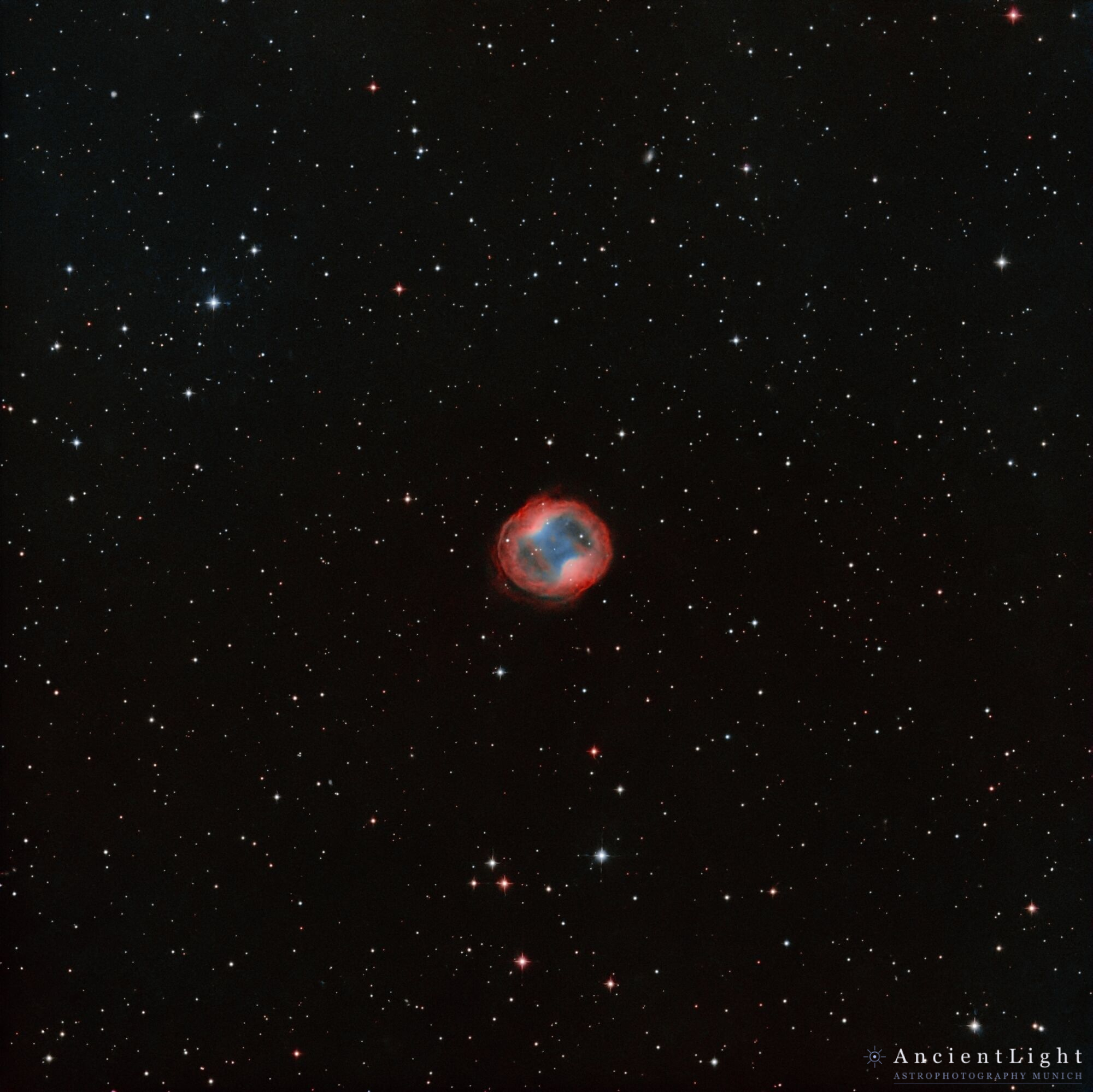
Jones-Emberson 1 Nebula in Lynx
Jones-Emberson 1 (PK 164+31.1), also known as the Headphone Nebula, is a 14th magnitude planetary nebula in the constellation Lynx at a distance of 1600 light-years from Earth. It is a larger planetary with low surface brightness. The 16.8-magnitude central star is a blue white dwarf.
Munich Bortle 6 · 2026-04-08/17 · TS PHOTON 154 f/4 · Umi17R · ToupTek 533M · 9h05m HO · N.I.N.A · Pixinsight
Munich Bortle 6 · 2026-04-08/17 · TS PHOTON 154 f/4 · Umi17R · ToupTek 533M · 9h05m HO · N.I.N.A · Pixinsight

M63 Sunflower Galaxy in Canes Venatici
Messier 63 also known as Sunflower Galaxy is a spiral galaxy in the northern constellation of Canes Venatici with approximately 400 billion stars. The distance to M63 is 29.3 million light-years.
Munich Bortle 6 · 2026-03-19/21 · Skywatcher 200P f/5 · Umi17R · ToupTek 533M · 10h55m LRGB · N.I.N.A · Pixinsight
Munich Bortle 6 · 2026-03-19/21 · Skywatcher 200P f/5 · Umi17R · ToupTek 533M · 10h55m LRGB · N.I.N.A · Pixinsight

IC443 Jellyfish Nebula in Gemini
IC 443 also known as the Jellyfish Nebula is a galactic supernova remnant located in the constellation Gemini along the ecliptic. It is approximately 5500 light-years from Earth.
Munich (Bortle 6) · 2026-01-15,2026-03-05 · TS PHOTON 154mm f/4 · IMX533M · 11h SHO · N.I.N.A · Pixinsight
Munich (Bortle 6) · 2026-01-15,2026-03-05 · TS PHOTON 154mm f/4 · IMX533M · 11h SHO · N.I.N.A · Pixinsight

Sh2-224 Rice Hat Nebula in Auriga
Sh2-224, often referred to as the Rice Hat Nebula, is a faint supernova remnant (SNR) located in the constellation Auriga. The distance is approximately 14700 light-years from Earth, the diameter is about 163 light-years. It formed about 20000 years ago from the death of a massive star.
Munich Bortle 6 · 2026-01-19/20/21 · TS PHOTON 154 f/4 · Umi17R · ToupTek 533M · 23h25m HO · N.I.N.A · Pixinsight
Munich Bortle 6 · 2026-01-19/20/21 · TS PHOTON 154 f/4 · Umi17R · ToupTek 533M · 23h25m HO · N.I.N.A · Pixinsight
2025

NGC7822 in Cepheus
NGC 7822, also known as the Question Mark Nebula, is a star forming complex in the constellation of Cepheus. The complex is believed to be about 3000 light-years distant, aged only a few million years. The complex includes one of the hottest stars within 1 npc of the Sun, namely BD+66 1673, that exhibits a temperature of nearly 45000 K and is about 100000 times brighter than the Sun.
Munich Bortle 6 · 2025-11-27/28 · Askar FRA400 f/5.6 · Umi17R · ToupTek 533M · 8h35m SHO · N.I.N.A · Pixinsight
Munich Bortle 6 · 2025-11-27/28 · Askar FRA400 f/5.6 · Umi17R · ToupTek 533M · 8h35m SHO · N.I.N.A · Pixinsight

NGC281 Pacman Nebula in Cassiopeia
NGC 281 (Pacman Nebula) is an emission nebula approximately 9200 light-years from earth in the constellation Cassiopeia. The nebula is a busy stellar nursery (H II region) composed primarily of ionized hydrogen gas energized by the intense ultraviolet radiation from IC 1590, a young, bright open cluster of stars embedded near its center. The Pacman Nebula has Bok globules, dense dark clouds of gas and dust that are undergoing gravitational collapse. The brightest member of the central cluster is HD 5005, a multiple star system featuring high-mass, hot O-type stars that drive the strong stellar winds shaping the nebula's structure.
Munich Bortle 6 · 2025-11-11/12/13 · Askar FRA400 f/5.6 · Umi17R · ToupTek 533M · 13h05m SHO · N.I.N.A · Pixinsight
Munich Bortle 6 · 2025-11-11/12/13 · Askar FRA400 f/5.6 · Umi17R · ToupTek 533M · 13h05m SHO · N.I.N.A · Pixinsight
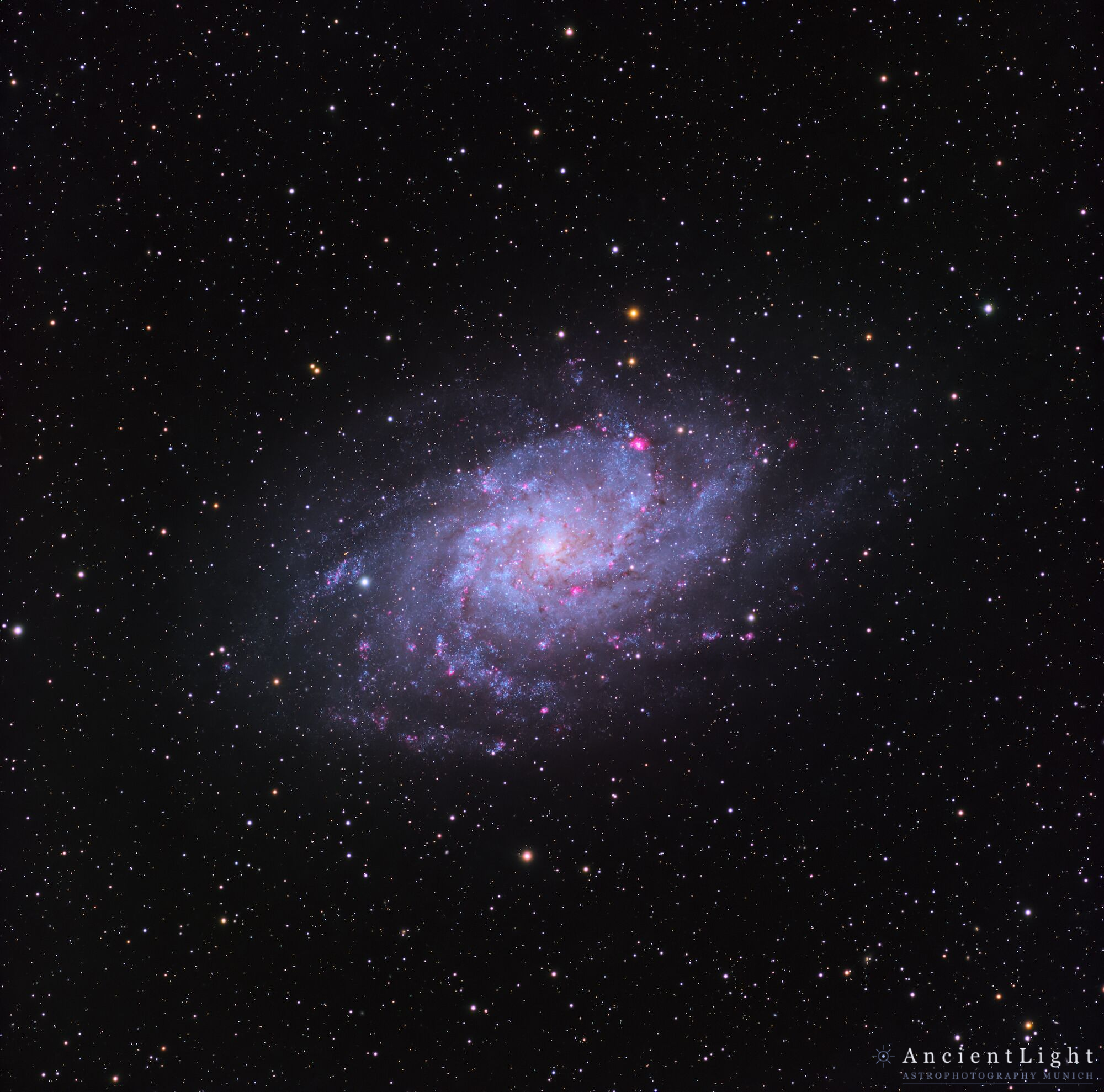
M33 Triangulum Galaxy in Triangulum
Messier 33 (Triangulum Galaxy) is a spiral galaxy (SA(s)cd) approximately 2.73 million light-years from earth in the constellation Triangulum. It is the third-largest member of our Local Group of galaxies, right behind the Andromeda Galaxy and our own Milky Way. Unlike the Milky Way, M33 is a relatively small galaxy with no central bar structure and a weak, compact nucleus. Its spiral arms are flocculent meaning they appear patchy, loose, and discontinuous. Despite its smaller size of about half the diameter of the Milky Way, M33 has a remarkably high rate of star formation. Its spiral arms are heavily populated with massive stellar nurseries, most notably NGC 604, one of the largest known H II regions in the Local Group, spanning nearly 1500 light-years across.

NGC6914 in Cygnus
NGC 6914 is a reflection and emission nebula complex approximately 6000 light-years from earth in the constellation Cygnus. It is a striking nebula complex located in the star-rich fields of the Cygnus constellation, embedded deep within the massive Cygnus OB2 stellar association. It is a textbook example of cosmic contrast, where brilliant blue reflection nebulae are superimposed on a vast, glowing backdrop of red hydrogen gas. The entire region is an active site of star formation, driven by the intense stellar winds and radiation pressure of the high-mass stars born within the Cygnus OB2 association
Munich Bortle 6 · 2025-09/10 · Askar FRA400 f/5.6 · Umi17R · ToupTek 533M · 22h31m HLRGB · N.I.N.A · Pixinsight
Munich Bortle 6 · 2025-09/10 · Askar FRA400 f/5.6 · Umi17R · ToupTek 533M · 22h31m HLRGB · N.I.N.A · Pixinsight

Sh2-132 Lion Nebula in Cepheus
The Lion Nebula (Sh 2-132) is a faint emission nebula located in the constellation Cepheus 10400 light-years away within the Perseus Arm of the Milky Way with a diameter of approximately 125 to 250 light-years.The nebula's glowing gas is powered by massive, intensely hot stars, most notably two Wolf-Rayet stars (WR 152 and WR 153ab) and several O and B-type stars.
Munich Bortle 6 · 2025-08-11/12/13/14 · Askar FRA400 f/5.6 · Umi17R · ToupTek 533M · 26h15m SHO · N.I.N.A · Pixinsight
Munich Bortle 6 · 2025-08-11/12/13/14 · Askar FRA400 f/5.6 · Umi17R · ToupTek 533M · 26h15m SHO · N.I.N.A · Pixinsight

NGC 7023 Iris Nebula in Cepheus
NGC 7023 is reflection nebula located about 1300 light years from Earth in the constellation of Cepheus. It is 6 light-years across. The nebula is illuminated by a magnitude +7.4 star HD 200775 which produces the blue emission.

M27 Dumbbell Nebula in Vulpecula
Messier 27 is an emission nebula surrounding a white dwarf in the constellation Vulpecula ("little Fox"), at a distance of about 1360 light-years and a core diameter of 2.5-3 lightyears.
Munich (Bortle 6) 2025-06-11/13/19/20· Skywatcher 200P f/5 · Umi17R · ToupTek 533M · 17h20m SHO · N.I.N.A · Pixinsight
Munich (Bortle 6) 2025-06-11/13/19/20· Skywatcher 200P f/5 · Umi17R · ToupTek 533M · 17h20m SHO · N.I.N.A · Pixinsight

NGC 6888 Crescent Nebula in Cygnus
The Crescent Nebula NGC6888 is an emission nebula in the constellation Cygnus, about 5000 light-years away from Earth. It is formed by the fast stellar wind from the Wolf-Rayet star WR 136 (HD 192163) colliding with and energizing the slower moving wind ejected by the star when it became a red giant around 250,000 years ago. The result of the collision is a shell and two shock waves, one moving outward and one moving inward.
Munich Bortle 6 · 2025-06-21/24/25 · Skywatcher 200P f/5 · Umi17R · ToupTek 533M · 11h40m HOO · N.I.N.A · Pixinsight
Munich Bortle 6 · 2025-06-21/24/25 · Skywatcher 200P f/5 · Umi17R · ToupTek 533M · 11h40m HOO · N.I.N.A · Pixinsight
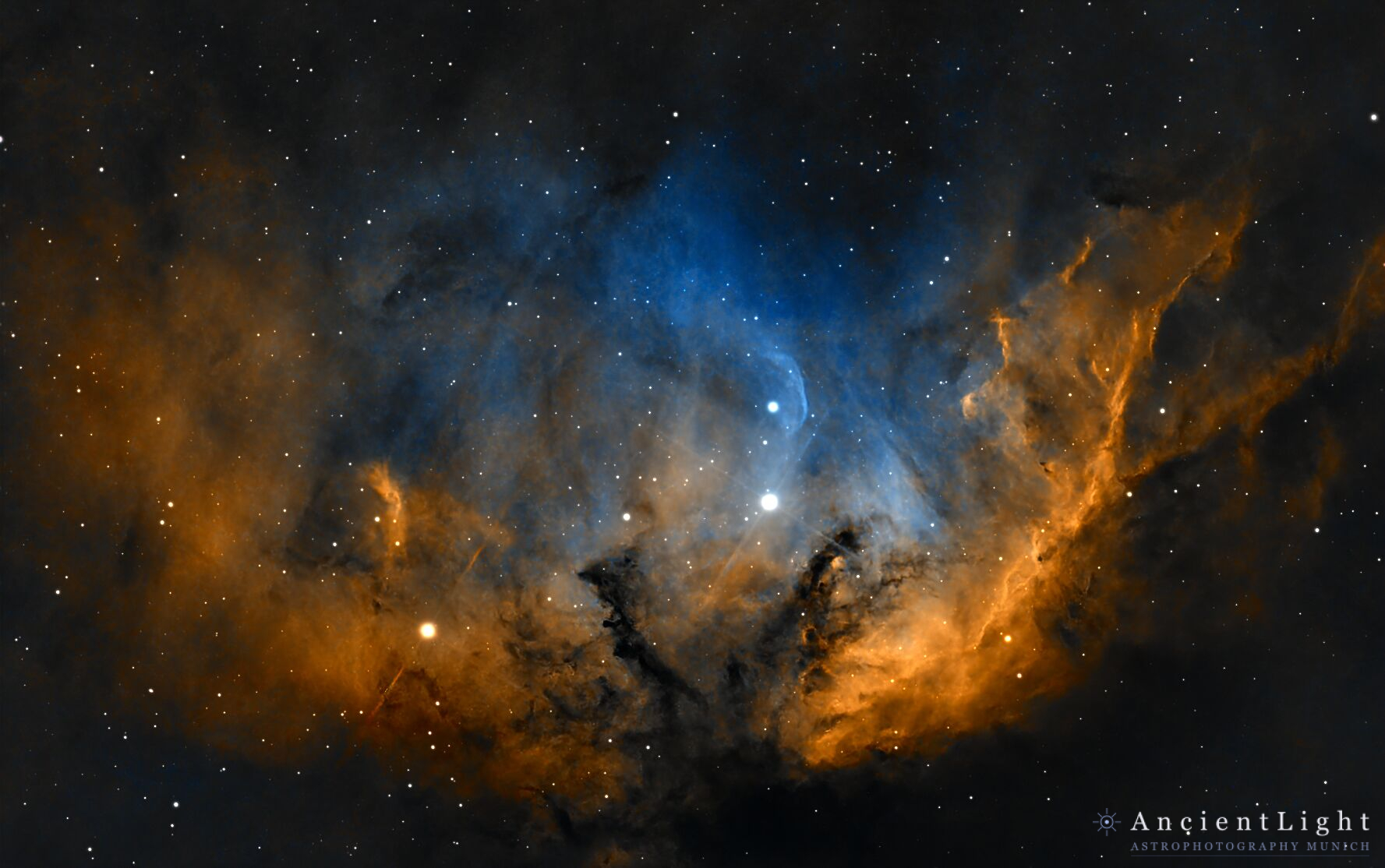
Sh2-101 Tulip Nebula in Cygnus
The Tulip Nebula (Sh 2-101) is a HII region emission nebula located in the constellation Cygnus at a distance of about 6000 light-years (5.7×10¹⁶ km) from Earth. Sh 2-101 is close to microquasar Cygnus X-1, one of the first suspected black holes.

M13 Star Cluster in Hercules
Messier 13 is one of the brightest and most famous globular clusters in the northern celestial hemisphere. It is a tightly packed spherical collection of estimated around 300,000 to 500,000 stars. M13 is incredibly old, with an estimated age of nearly 12 billion years. It consists mainly of ancient, metal-poor stars, populated by numerous red giants and distinct "blue stragglers."
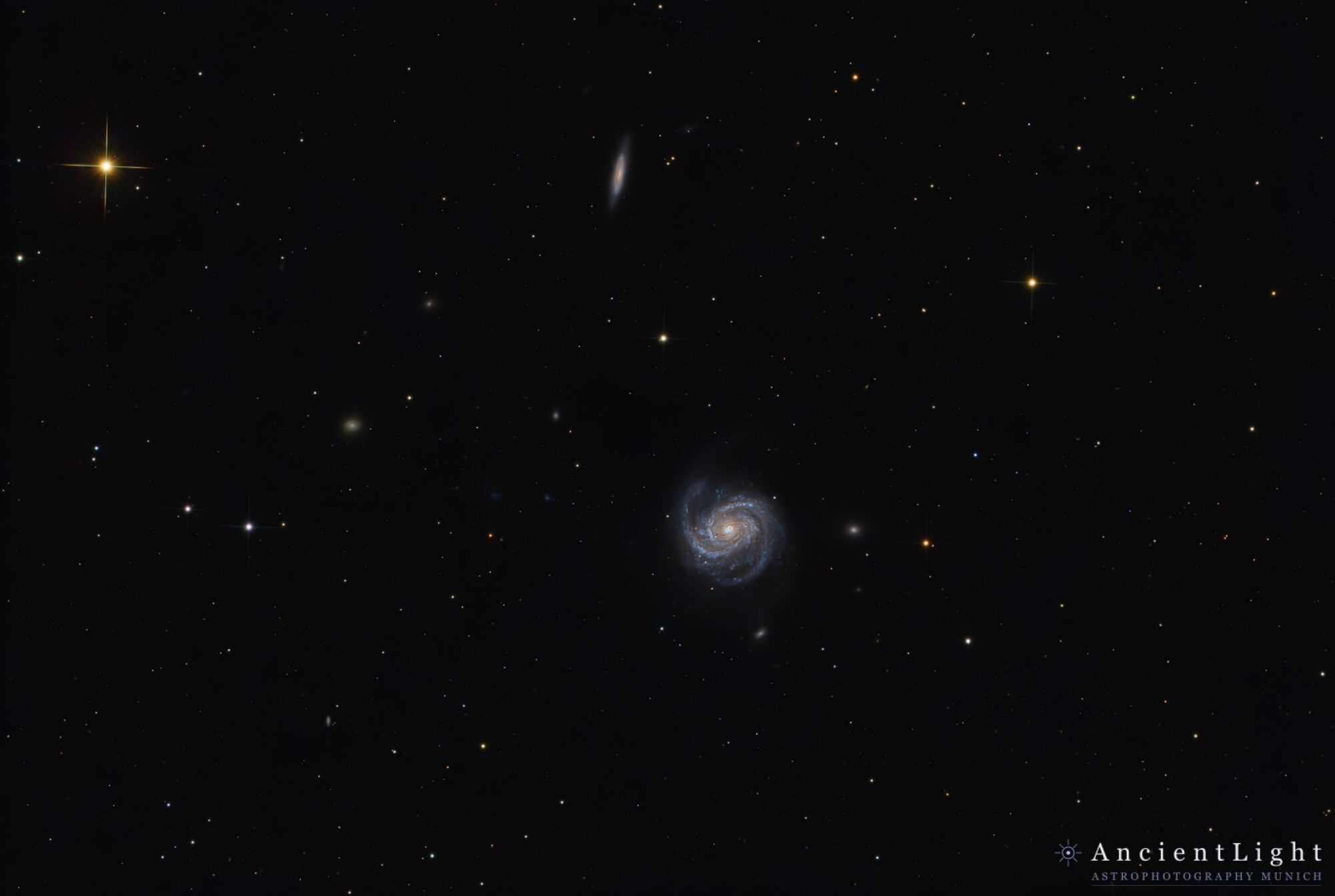
M100 Mirror Galaxy

M51 Whirlpool Galaxy in Canes Venatici
Messier 51 (The Whirlpool Galaxy) is an interacting spiral galaxy (SA(s)bc) approximately 23 million light-years from earth in the constellation Canes Venatici – very close to the handle of the Big Dipper. It is one of the most iconic and photogenic deep-sky objects in the night sky, a "grand design" spiral galaxy, viewed almost perfectly face-on from Earth with its smaller companion dwarf galaxy, NGC 5195, which appears attached to the tip of one of its prominent spiral arms.
Due to this cosmic collision, the spiral arms are highly active stellar nurseries, densely packed with clusters of hot, young, blue stars and countless glowing nebula pockets. M51 hosts an active galactic nucleus (classified as a Seyfert 2 galaxy), powered by a supermassive black hole at its core.

März M101 Pinwheel Galaxy

IC1805 Heart Nebula in Cassiopeia
IC 1805 (The Heart Nebula) is an emission nebula and open cluster approximately 7500 light-years from earth in the constellation Cassiopeia. In the Perseus arm of our galaxy, this massive complex of glowing interstellar gas and dark dust lanes spans roughly 200 light-years across. Deep in the center of the nebula lies Melotte 15, a young open cluster of stars only about 1.5 million years old. It contains several extremely hot, high-mass O-type stars. The intense radiation and powerful stellar winds from these central giants sculpt the surrounding gas clouds into towering, 3D-like pillars and drive the entire nebula's glow.

NGC2237 Rosette Nebula in Monoceros
The Rosette Nebula is an HII region located near one end of a giant molecular cloud in the Monoceros (Unicorn) region of the Milky Way Galaxy. The cluster and nebula lie at a distance of 5000 light-years from Earth and measure roughly 130 light years in diameter.
Telescope: ASKAR FRA400
Telescope: ASKAR FRA400

NGC 1499 California Nebula
The California Nebula (NGC 1499 or Sh2-220) is an emission nebula located in the constellation Perseus. It lies at a distance of about 1000 light years from Earth. Its fluorescence is due to excitation by the bright star Xi Persei, also known as Menkib)